Subscribe: RSS
The Rule That Broke
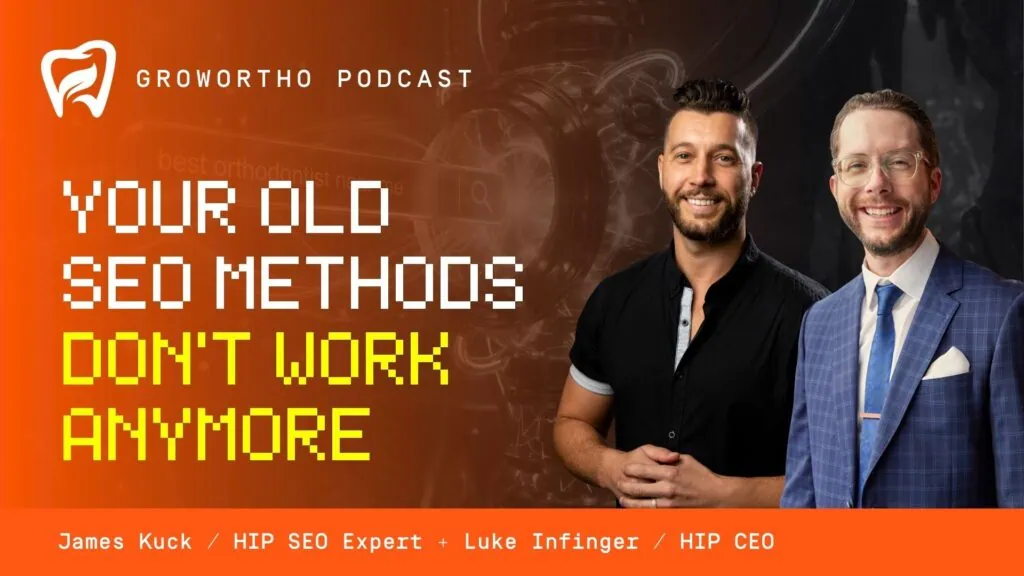
For a decade, SEO had one simple goal: rank higher than everyone else.
That rule just died.
Patients are not typing “orthodontist near me” and clicking through five websites anymore. They are asking ChatGPT. They are reading Google AI Overviews. They are using conversational tools that skip the ten blue links entirely.
Here’s what most practices have not realized yet.
AI search engines do not rank practices. They select them.
If you are not selected, you are invisible. Your beautiful website does not matter. Your years of “doing SEO” do not matter.
This shift changes everything.
Get your Free SEO Audit: https://hip.agency/contact/
Grab your copy of Orthodontic Practice SEO: Amazon: https://www.amazon.com/dp/B0GGBWLBLR Apple: https://books.apple.com/us/book/orthodontic-practice-seo/id6757766846
From Rankings To Recommendations
Traditional search worked like a phone book.
You searched. You clicked. You compared. You decided.
AI search collapses that entire process into one conversation.
Instead of forcing patients to research five options, AI tools recommend providers directly. Often just one or two practices. That’s it.
This is not a ranking system. It’s a trust system.
Google’s AI Overviews answer questions directly at the top of results. ChatGPT does not pretend to be a search engine. It acts like a knowledgeable assistant guiding decisions in real time.
When a parent asks, “Who’s the best orthodontist for Invisalign for my teen near me?” the AI does not say:
“Here are ten websites. Good luck.”
It says:
“Based on your needs, I recommend these providers.”
If you are not in that answer, you do not get a second chance.
Why Your Old SEO Playbook Just Stopped Working
Classic SEO rewarded keywords, backlinks, page optimization, and technical performance.
All of that still matters, but it’s no longer enough.
AI engines work differently. They summarize instead of list. They cite instead of rank. They select sources instead of pages.
Instead of ordering websites by relevance, AI evaluates who appears trustworthy, who demonstrates real expertise, and who can be safely recommended without risk.
This explains why some practices with fewer backlinks or lower traditional rankings suddenly appear in AI answers while others with “strong SEO” vanish completely.
AI is not asking, “Who optimized best?”
It’s asking, “Who do I trust enough to recommend?”
The Real Ranking System — Trust Over Traffic
Every AI search engine relies on the same decision framework. ChatGPT, Google AI Overviews, Gemini, Perplexity. All of them.
They look for three core signals.
1. Topical Authority
Do you own the topic, or are you just scratching the surface?
One Invisalign page optimized for keywords no longer signals expertise. AI looks for topic ownership. A full ecosystem of content proving you understand the subject from every angle.
Cost and financing. Treatment timelines. Comparisons versus alternatives. Maintenance and care. Suitability for teens versus adults. Risks, outcomes, and expectations.
If your site answers only one of these, AI assumes you are not the expert.
2. Verifiable Credibility
AI does not trust claims. It trusts proof.
It actively scans for board certification, recognized provider tiers, awards and “best of” recognition, years in practice, case volume, and external validation.
These signals matter more now because AI must justify its recommendations. It cannot guess.
3. External Trust Signals
AI does not rely solely on your website. It cross-checks reviews across multiple platforms. Not just Google. Authoritative directories. Press mentions. Industry listings. Community validation.
The more independent sources confirm your legitimacy, the more comfortable AI becomes recommending you.
Why One Page Will Never Be Enough Again
For years, SEO rewarded focus.
Pick a keyword. Optimize a page. Build links. Win.
AI rewards depth.
When someone asks about Invisalign, AI does not want a sales page. It wants confidence that you are the authority.
That’s why topical clusters matter now. One core Invisalign page. Supporting pages on cost, care, timelines, and alternatives. FAQs written in clear, extractable language. Structured formatting AI can easily parse.
This is not about writing more content for the sake of content.
It’s about removing doubt.
AI selects practices that leave no unanswered questions.
The Trust Signals That Actually Trigger Recommendations
Here’s where most practices fall short.
They have credibility. They just do not surface it clearly enough for AI to verify.
AI strongly favors practices that explicitly showcase board certification with outbound verification links, awards tied to authoritative publications, review volume across multiple platforms, mentions from high-authority websites, and transparent doctor bios with credentials and education.
This is why press placements and authoritative citations now punch far above their weight.
A single mention on a trusted outlet can matter more than dozens of generic backlinks. AI recognizes the source.
Being Selected Beats Being Ranked
Traditional SEO is competitive. AI visibility is compounding.
Once AI begins recommending a practice, it appears repeatedly in similar conversations. Each mention reinforces authority. The practice becomes a default choice.
This mirrors early Google SEO, but with fewer spots and higher stakes.
In classic search, being number five still meant traffic.
In AI search, being number five often means nothing.
Only the selected practices win.
How To Become The Practice AI Chooses
This is not theory. It’s execution.
Here’s what actually moves the needle.
Shift from pages to topic ecosystems. Own entire treatment categories, not just keywords.
Surface credibility aggressively and clearly. Credentials, awards, and experience should be impossible to miss.
Expand reviews beyond Google. AI pulls from multiple platforms. Diversification matters.
Secure authoritative citations, not random links. Focus on sources AI already trusts.
Structure content for AI extraction. Clear headers, FAQs, concise answers, and schema markup.
Actively monitor AI recommendations. Search manually. Track visibility. Learn from who’s being selected and why.
Trust Is The New Ranking Factor
SEO did not disappear. It evolved.
The practices that will win over the next decade are not the ones chasing algorithms. They are the ones building undeniable credibility.
AI does not reward clever tricks. It rewards certainty.
In a world where patients increasingly let AI guide their decisions, the question is no longer “How do I rank higher?”
It’s “Why should AI trust me enough to recommend me at all?”
Answer that convincingly, and rankings stop mattering.