Subscribe: RSS
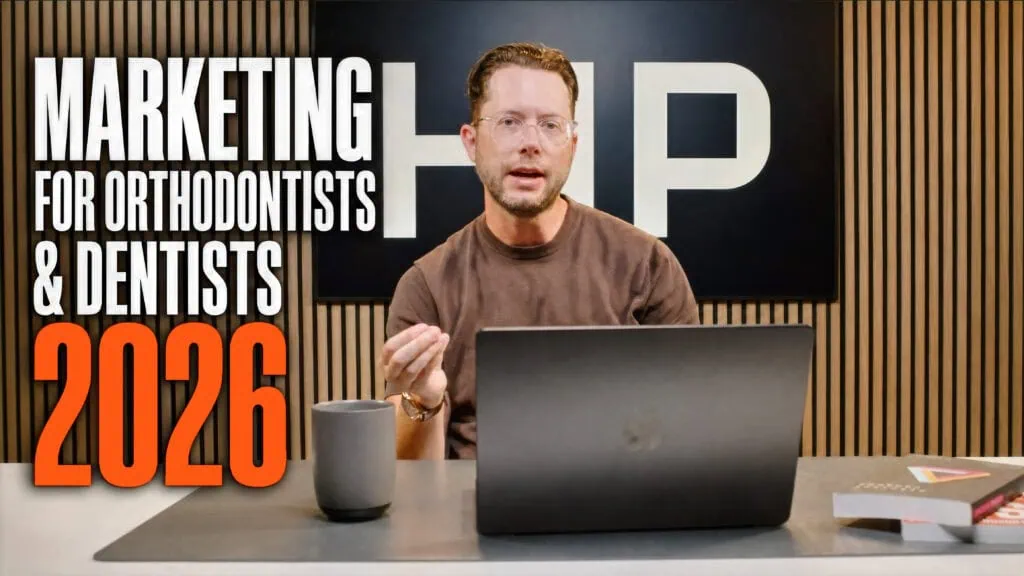
Episode: Marketing for Orthodontists and Dentists in 2026
Show: GrowOrtho
Host: Luke Infinger, Founder and CEO, HIP Creative
Published: [07-2-26] | Last updated: [07-2-26]
Summary: Effective marketing for orthodontists follows an order: build a strong local brand first, make the practice findable second, and only then amplify with paid ads. Skip the sequence and you waste an estimated 30 to 40 percent of your ad budget on leads you can’t reach or convert. The fastest wins are usually already sitting in the practice: a Google Business Profile with 100-plus images gets 500 percent more calls, calling a lead within five minutes and following up six times raises contact rates sharply, and getting digital leads into the chair within 72 hours keeps no-show rates from doubling. Paid ads work, and they can perform 10 to 20 times better once the brand and findability are in place, but they are the last layer, not the first.
Topics covered: marketing order and sequence, how patients find a practice, SEO and the map pack, short-form vs. long-form video, the five by six follow-up method, the ads-before-foundation trap, landing pages and ad creative, Google Business Profile optimization, reviews, the 72-hour rule, lead economics, and a local Dream 100 referral strategy.
Key entities: Luke Infinger, HIP Creative, GrowOrtho, Google, Google Ads, Meta (Facebook and Instagram), YouTube, TikTok, ChatGPT, Perplexity, Yelp, Opus Clip, Invisalign, clear aligners, Google Business Profile, American Association of Orthodontists (AAO), Chet Holmes, Microsoft, Time magazine.
About the author
By Luke Infinger CEO & Co-Founder, HIP Creative | Author |
Luke Infinger has spent more than 12 years helping dental and orthodontic practices grow through marketing, software, and education. He is the founder of HIP Creative, which works with more than 500 dental and specialty practices across the country, and the creator of Practice Beacon, a lead-tracking CRM built specifically for dental and orthodontic teams. His work has included taking practices from regional obscurity to nationally recognized growth benchmarks, among them helping an orthodontist become the fastest-growing in the country by 2018. He is also the author of multiple books on practice growth and a sought-after speaker for dental continuing education events.
LinkedIn: https://www.linkedin.com/in/luke-infinger-b36a001b/
Most conversations about marketing for orthodontists start in the wrong place.
A practice owner wants more patients this week, so the conversation jumps straight to paid ads: run Meta, run Google, turn on the faucet. Ads can absolutely move volume, but they are almost never the first thing a practice needs to get right.
Marketing works in an order, the same way orthodontic treatment does. You don’t start a case with rubber bands. There’s an evaluation, then phase one, then phase two, then the finishing details, each in sequence for the best result. Marketing has its own sequence: brand first, findability second, amplification last. Layer paid ads on top of a strong local brand and they can perform 10 to 20 times better in lead volume, lead quality, and show rate. Layer them on top of nothing and you burn money.
This post walks the whole sequence Luke Infinger lays out in the episode, with the numbers behind each stage, so you can find the leaks in your own practice before you spend another dollar on ads.
Key takeaways
- Marketing runs in a sequence: brand, then findability, then amplification. Paid ads layered on a strong local brand can perform 10 to 20 times better than ads run on a weak foundation.
- 90 percent of patients search online, 72 percent of those searches still start on Google, and 70 percent of clicks go to the top three map-pack results. If you’re not in the top three, you miss most of the traffic.
- Call a new lead within five minutes and follow up at least six times. Waiting past five minutes cuts your odds of reaching them by 400 percent; six follow-ups raise your odds of connecting and qualifying by 70 percent.
- Get digital leads into the chair within 72 hours or the no-show rate doubles or triples.
- A Google Business Profile with 100 or more images gets 500 percent more phone calls; the average practice has about 15. A 4.9 rating with fresh reviews outperforms a perfect 5.0.
- Running paid ads before the foundation exists wastes an estimated 30 to 40 percent of the budget, and 77 percent of ads still point to a generic homepage instead of a matched landing page.
- An organic lead costs about $30; a paid lead can cost six times more, around $180, but $180 in can return roughly $6,000 in gross revenue once the foundation is right.
Why should orthodontists build their brand before running paid ads?
The costliest mistake in practice marketing is running paid ads before the foundation exists. When nobody in the community recognizes your name, ads have nothing to reinforce. You’re a cold offer from an unknown practice, and the leads reflect it: hard to reach, slow to respond, and prone to no-showing. An estimated 30 to 40 percent of ad budget gets wasted on poor conversions when practices jump ahead like this.
The sequence Luke Infinger uses at HIP Creative is brand, then findability, then amplification. Brand is your reputation and positioning in the community. Findability is everything that makes you show up when people search. Amplification is paid advertising to the masses. Ads belong last because they multiply whatever foundation is underneath them. Most practices haven’t optimized their organic presence, so paying to accelerate a weak foundation just spends money faster.
If your ads are striking out right now, that’s the signal. You’ve skipped ahead, and the fix is to back up and build brand equity through community outreach and a boots-on-the-ground strategy before you scale spend.
How do patients actually find an orthodontic practice in 2026?
Roughly 90 percent of patients search online for a dentist or orthodontist, and 72 percent of those searches still begin on Google. That share will shift as more people use large language models like ChatGPT and Perplexity, but Google is still where the majority start. Of the people who search, about 70 percent click one of the top three results, which on mobile and often desktop is the map pack: the map, the website link, and the click-to-call button clustered at the top. People rarely scroll past it. If your practice isn’t ranking in one of those first three positions, you miss most of the available traffic, which is why local SEO matters so much.
Patients also take their time. On average, a patient researches for about two weeks before engaging, and interacts with your brand five to seven times before taking action. A mom weighing Invisalign for retreatment isn’t calling on the first visit. She’s reading, comparing, and checking you against competitors. And 76 percent of people judge a provider’s credibility on how the website looks, feels, and functions. You can tell the best story in your market, but with no team photos, no video, and no clear new-patient process on the page, you lose patients who never call.
What kind of video content actually brings orthodontic patients through the door?
Short-form video dominates how people consume content, especially for procedures like implants, braces, and aligners. But the move that pays off most is to record long-form video, publish it on YouTube (which is itself a search engine), and optimize the thumbnail, title, description, and tags so it ranks. From there, a tool like Opus Clip can cut that long-form video into short clips for YouTube Shorts, Instagram, Facebook, and TikTok. You get the SEO benefit of the long-form asset and the reach of the clips from one recording.
The trap Luke Infinger sees constantly is practices pouring their time into trending TikTok videos. Those videos can go viral, but when you check who’s actually watching, it’s rarely people in your radius. Thousands of views from outside your community will never become patients. Reverse the priority: make the videos your local audience is actively searching for, moms researching treatment, young adults researching retreatment, smile aesthetics and whitening. Rank those on YouTube, embed them on your website, and use an LLM to generate an FAQ section under the embedded video, which helps the page rank. Then, if you still have time, add the fun trending videos for personality. They show who you are; they just don’t fill the schedule.
What is the five by six method for following up with new patient leads?
Follow-up used to be a single phone call. Now it takes a system. The five by six method means you call a new prospective patient within five minutes and have a process to follow up at least six times.
The five-minute window is not arbitrary. Your likelihood of contacting a patient drops by 400 percent if you don’t call within the first five minutes. And following up at least six times produces a 70 percent increase in the likelihood of both contacting and qualifying that lead. This is where automation earns its keep: a notification to the front desk to call immediately, another prompt to call within two hours, another the next business day, with text messages going out after each attempt. And leave a voicemail every time. Every voicemail, text, and email is a breadcrumb, and when a lead sees all of them together, it clicks: “Oh, that’s the practice I looked at the other day.”
That layered cadence matters because attention is scarce. A Microsoft study published in Time magazine found human attention spans have dropped below that of a goldfish, roughly six to seven seconds. People are inundated with spam texts, emails, and social feeds, so a single missed call disappears instantly. Multiple coordinated touches create the priority and urgency that get someone to act.
Why does running paid ads before the foundation waste money?
Beyond the wasted budget, the mechanics of most paid campaigns are broken. About 77 percent of paid ads point to the homepage of a website, which is generic by design and matches no specific offer. If you’re running a campaign for $500 off braces or clear aligners for the month of July, the click needs to land on a dedicated landing page where the headline, the offer, the colors, and the graphics all match the ad. A homepage can’t do that.
The creative itself is usually the opposite of what works. Practices commission highly produced videos and polished Canva graphics, and that polish often reads as an ad and gets ignored. Content that looks organic and natural, selfie-style, casual, the way a real creator posts, tends to resonate more because it doesn’t feel like advertising.
Underneath all of it is what Luke Infinger calls the congruence effect: closing the gap between your clinical reality and your brand. Every doctor believes they’re the best in their market, and many are excellent clinically. But when their brand looks nothing like best-in-class, the two are out of alignment. Think of the hole-in-the-wall restaurant only locals know versus the beautiful, magazine-featured spot with the Michelin chef. The restaurant that lasts is the one where the best food and the best presentation collide. If you believe you offer the best care, you have an obligation to build the brand and system that lets you treat the most people, because if you don’t, a less-skilled competitor with better marketing will.
How do you improve findability on your Google Business Profile?
Your Google Business Profile is one of the fastest levers in the whole system, and most practices barely use it. Profiles with 100 or more images get 500 percent more phone calls. When HIP Creative runs a practice profit diagnostic, the average profile has about 15 images. Loading it up with real photos is one of the clearest paths to showing in the map pack and earning more calls.
Reviews are the other half. 87 percent of prospective patients read reviews before choosing a provider, and Google rewards recency, not just totals. A practice with 500 reviews that stopped collecting them loses to a practice with 120 that’s actively earning and responding to new ones. And a perfect 5.0 is not the goal. A 4.9 rating outperforms a flawless score because it reads as real and human. Every practice eventually gets a difficult patient and a bad review; that imperfection actually helps. Reaching the three-pack pays off directly: you get 93 percent more calls once you’re in that top-three map cluster.
What is the 72-hour rule for new patient leads?
Once amplification is working and digital leads are coming in from your website, Meta ads, or Google Ads, speed to appointment becomes the constraint. The 72-hour rule is simple: if you don’t get a new digital lead into the practice within 72 hours, three days, the no-show rate doubles or triples.
The practical implication is scheduling. You have to hold open a few appointment slots specifically so digital leads can be seen quickly. A lead who has to wait a week and a half has time to cool off, book elsewhere, or forget entirely. Protecting near-term availability for fresh leads is what converts the money you spent generating them.
When do paid ads finally make sense, and what do they cost?
Once brand, findability, and follow-up are in place, ads make sense as the amplification layer. The economics are worth understanding before you turn them on. A lead generated organically through SEO, your website, and your YouTube videos costs roughly $30 once you divide the cost of building those assets across the patients they bring in. A paid lead can cost about six times more, around $180. Same patient, six times the price.
That sounds bad until you run the return. Luke Infinger’s point is that he would happily pay $180 per lead if he could keep scaling, because $180 in can return roughly $6,000 in gross revenue. That’s gross, not profit, but the math still supports paying up for volume once the foundation makes those leads convert. The mistake is paying the premium before organic is optimized, so you’re overpaying for leads a weak brand can’t close.
How do you use a local Dream 100 strategy to grow referrals?
The advanced play comes from Chet Holmes: write down the most connected people and places in your own town, then pursue them with discipline. This is a local version of the Dream 100. Your targets might be local podcasts, neighborhood Facebook groups, popular community accounts, or people with local YouTube channels. They might be other businesses serving the same families, and for the aesthetic adult patient, med spas offering Botox, injectables, facials, or peels are a natural fit. An Invisalign special promoted to a med spa’s audience is a warm match.
The underlying goal is to increase your sphere of influence and your trust in the local community, then convert that trust into referrals. Finish with the self-audit Luke Infinger leaves practice owners with: if your best patient referred you to a friend, and that friend googled you, what would they find? Would a competitor rank above you? Would your site impress them, or would the photos look old and the video be missing while the practice across the street has the state-of-the-art site? Go online and search like a patient who doesn’t know you. Compare yourself against whoever ranks in your market, click through, read the copy, watch the videos, and ask honestly whether you’d choose you. Most doctors who run that exercise spot exactly what to fix within minutes.
FAQ
At what age should a child first see an orthodontist? The American Association of Orthodontists (AAO) recommends a first orthodontic evaluation by age 7. Depending on airway considerations some evaluations happen sooner, followed by observation, phase one, and phase two treatment as needed. Luke Infinger uses this to make a point about marketing: like treatment, marketing has a correct order and sequence.
How fast should a practice call a new patient lead? Within five minutes. Waiting longer cuts your likelihood of contacting that lead by 400 percent. Pair the fast first call with at least six follow-up attempts across calls, texts, voicemails, and emails, which raises your odds of connecting and qualifying by 70 percent.
How many images should be on a Google Business Profile? Aim for 100 or more. Profiles with 100-plus images earn 500 percent more phone calls, yet the average practice profile has only about 15. Adding real photos of the office and team is one of the fastest ways to rank in the map pack.
Is a perfect 5.0 star rating better than 4.9? No. A 4.9 rating with fresh, recent reviews outperforms a perfect 5.0 because it reads as real and human rather than staged. Google also rewards practices that keep earning and responding to reviews over ones that stopped collecting them.
How much does a paid patient lead cost compared to an organic one? An organic lead runs about $30 once asset costs are spread across the patients they produce. A paid lead can cost roughly $180, about six times more. The paid premium is worth it once the foundation is in place, since $180 in can return around $6,000 in gross revenue.
Glossary
Map pack: The cluster of the top three local business results Google shows with a map, website link, and click-to-call button. It captures roughly 70 percent of local search clicks.
Five by six method: Call a new lead within five minutes and follow up at least six times across calls, texts, voicemails, and emails.
72-hour rule: Get a new digital lead into the practice within three days or the no-show rate doubles or triples.
Congruence effect: Closing the gap between a practice’s clinical quality and how good its brand looks, so both signal best-in-class.
Dream 100: Chet Holmes’ strategy of identifying the most connected people and places in your market and pursuing relationships with them deliberately.
Google Business Profile: The free Google listing that controls how a practice appears in local search and Maps, including photos, reviews, hours, and calls.
Full episode transcript
Order and sequence [00:00]
We’re going to talk about marketing for orthodontists and dentists in 2026, and the first thing I want to talk about is order and sequence. I’ve talked to thousands of doctors at this point and thousands more business owners, and the way culture is programmed is that we want everything now. I fall into it too: how do I get better prospective patients today? A lot of those conversations end up turning into paid advertising, so people jump straight to ads. How can we run Meta ads, Facebook and Instagram, and Google Ads? That’s great, but there’s an order and sequence to it, and ads are typically not the first thing you need to get right for your marketing to work.
It’s like the question of when a child should first see an orthodontist. Age 7. Depending on what you believe about airways it may be sooner, but the AAO states age 7. Then there’s an observation, maybe phase one treatment, phase two treatment, and something like rubber bands, which get introduced later in treatment. To have success with patients, you need the treatment in the right order and sequence for the best results. The same is true for marketing.
What I find is that for practices with the best brand in their community, once you start to layer in digital like Meta ads and Google Ads, it can work 10 or 20 times better in attracting volume, better quality leads, and getting people to show up. We’re going to break that down and probably break a lot of the myths you currently believe. So let’s talk about how patients find you. This is no surprise: 90 percent of patients search for a dentist or orthodontist online.
How patients find you [02:37]
72 percent of those searches still begin on Google. That will change as more people use LLMs like ChatGPT, or something like Yelp or Perplexity, but the majority still use Google. 70 percent of the clicks happen on the top three results, and on a phone, sometimes even desktop, we call that the map pack: the map, the website, the phone call. People don’t look past it. If you’re not positioned in one of the first three positions, you’ll miss most of the traffic. So SEO is very important, and it’s becoming more complex with AI as people generate more content. The caveat is that search engines don’t love content that’s purely AI-generated because it doesn’t sound human. There are frameworks: I could take this video I’m recording, give it to AI with my voice, my real results, my case studies, and my stories, and syndicate that across multiple mediums. That’s how you want to create content. Creating content straight from an LLM is typically not the way to go if you actually want to rank.
Before people ever call you, they’re vetting you online. On average, a patient researches for two weeks before engaging. Yes, there are impulse buyers, and yes, on Meta you can get in front of someone right then, and yes, some people search Google and click to call right away when their dentist says it’s time for Johnny to see an orthodontist. But if a mom is researching, or if I want to be retreated and I’m looking at Invisalign or clear aligners this time, I’m spending about two weeks researching. Who’s answering my questions? Then, once I want to see the orthodontist, how am I finding them and interacting with their brand? On average, a patient interacts with your brand between five and seven times before taking action.
And 76 percent of people judge credibility on how the website looks, feels, and functions. You could tell the best story, but without images, great photos of you and your team, or videos of you explaining the new patient process, you’re losing patients. Take this information and plug all the leaks in your bucket, because most people are already sitting on hidden gaps and revenue opportunities. If you fix what you already have, you could be as busy as you want, or at least understand your true baseline before you start adding things.
Video that actually works [06:27]
People are taking in video in the masses with short form. We still watch long-form like Joe Rogan, but for implants or orthodontics, brackets and aligners, a lot of those videos are short form. What you can do is record long-form videos for YouTube, optimize the thumbnail, headline, description, and tags, then take a tool like Opus and create short-form clips to post as YouTube Shorts and on Instagram, Facebook, and TikTok. YouTube is a search engine, so you gain the SEO benefit and the clips.
What I see a lot of dental, ortho, and medical offices doing is spending their time on TikTok trending videos. That’s not inherently bad, but the reality is most people watching those aren’t in your community. If a TikTok goes viral, you’re getting thousands of viewers who will never become patients. When I ask offices what videos they’re making, they only point to trending videos. I’d reverse that. Create videos people are actually searching for in your community: moms doing research, young adults researching retreatment, smile aesthetics, whitening. Get in front of those people with YouTube, then use those videos for short-form clips. If you still have time, add fun trending TikToks for personality, but they largely aren’t bringing you patients in your community. Those long-form YouTube videos can also live embedded on your website, and you can use an LLM to add FAQs below the video, which is good for ranking.
The five by six method [08:43]
Years ago, follow-up looked completely different. For a dental or orthodontic practice it wasn’t even an email, it was maybe a phone call. There’s something called the five by six method: you need to call a prospective patient within five minutes, and you need a process to follow up at least six times. On average, there’s a 400 percent decrease in your likelihood to contact a patient if you don’t call within five minutes. And there’s a 70 percent increase in likelihood of contacting and qualifying if you follow up at least six times.
That’s where automation comes in. Maybe there’s a notification to your front desk to call right away, another to call within two hours, another within 24 hours, the next business day, with text messages going out after each call. And you should leave a voicemail, absolutely, because all these things are breadcrumbs connecting the dots. If you hold up your phone today, how many missed calls do you have? I already have six or seven. How many left a voicemail, sent a text, sent an email? If someone does all those things, I go, oh, that’s that thing I clicked on the other day. I ordered a Tempur-Pedic mattress and forgot about it, and there was this cadence: calls, voicemails, emails, a text. Oh yeah, I’ve got to schedule that, and then I got it done.
We’re inundated in today’s culture with spam texts, from lenders and politicians, plus emails, Facebook, Instagram, TikTok. You have to do something to stand out in a very noisy world. There was a study, I believe by Microsoft, published in Time magazine, that proved humans have a shorter attention span than goldfish, something like six or seven seconds. We forget what we were just doing. Even as you listen to me now, you may be texting or checking your schedule. Focus is at an all-time low. We bring priority back up by placing urgency around it. That’s how you get people to take action.
The trap: ads before the foundation [12:00]
Now let’s talk about the trap, which is ads before the foundation, what I mentioned at the start. The costliest mistake in this space is running paid ads before the foundation exists. An estimated 30 to 40 percent of ad budget is wasted on poor conversions when you jump ahead and build on a bad foundation. Nobody knows who you are, so we’ve got to create brand equity, the positioning in your community, first.
77 percent of paid ads point to a homepage of a website. A Google Ad clicking to a homepage isn’t specific. Is the call to action right? Is the headline optimized? There needs to be a dedicated landing page. If I’m running a campaign for $500 off braces or clear aligners, only for July, a July 4th special, the page needs to match: the headline, the colors, the graphics, is there a video? And with paid ads, people think highly produced videos or beautiful Canva graphics are the answer, but a lot of that doesn’t resonate because it looks too polished. Content creators walk around selfie-style or take a photo of something. How can we look organic and natural in our ads? There’s a whole formula you’ve probably been misguided on.
So there’s a better way. If you’re striking out with paid ads, saying these are bad leads, we can’t reach them, they won’t respond, we can’t get them to show up, then you’ve jumped ahead and you don’t have the right foundation or brand equity in your community. You need to plan community outreach and a boots-on-the-ground strategy. I have a whole course on community outreach, and we can drop the link. That’s what you focus on first. Back to the order: brand, then we layer in findability with SEO so you can get in front of searches, and then amplification, getting out to the masses with paid ads. I call this the congruence effect.
The congruence effect [14:48]
The congruence effect is closing the gap between your clinical reality, how good you are, and your brand. I’ve never talked to a doctor who thinks they’re second or third best; they’re number one. You’re excellent at your craft, you’ve gone to school forever, done specialty residencies. But when I look at people’s brands, they don’t resemble best in class. We have to close that gap so everything is congruent. You’ve probably been to a hole-in-the-wall spot only locals know about, and it doesn’t look that good, and then a beautiful new restaurant with a Michelin chef featured in the magazine, which may not be as good as the hole in the wall. When those two things collide, the best food and the best presentation, that’s the restaurant that lasts. That’s what you want to be as a dentist or orthodontist: the best care and the best marketing. If you believe you can offer the best treatment, you have a moral obligation to build the strategy and system to treat the most people, because if you don’t, who will?
Findability [15:50]
So let’s talk about findability. In terms of Google Business Profiles, you get 500 percent more phone calls with 100 images or more on your profile. On average, when we do a practice profit diagnostic, there are about 15 images. So how do you get a lot more images on there, so Google rewards you by showing you in the map pack and getting more calls?
87 percent of prospective patients read reviews before choosing a provider. Google rewards people who keep getting reviews. If you have 500 but stopped, Google rewards the person with 120 who’s actively getting them today and responding to them. And a 4.9-star rating beats a perfect five, because it doesn’t look perfect, it looks real and authentic. Every business has had a difficult patient, so you’re going to get dinged, it’s going to happen, but that 4.9 actually performs better because it’s human. You get 93 percent more calls once you reach the three pack, that map pack. If you’re not in the top three, you’re missing out on tons of prospective patients.
The 72-hour rule [17:39]
I talked about the five by six method; now the 72-hour rule. Once amplification starts and you’re getting more prospective patients from your website, Meta ads, or Google Ads, if you don’t get them into the practice within 72 hours, three days, your no-show rate is going to double or triple. So you have to create some slots within the schedule to get those digital leads in quickly.
When ads make sense [18:32]
Now ads make sense. We’ve gone through brand, findability, amplification, and now you add advertising. A lead organically coming from SEO, your website, and those YouTube videos could be about $30 if you break down what it cost to create those assets and divide it across the patients you get. A paid lead could be six times higher, so the same patient at six times the cost. Would I pay $180 if I could keep scaling and getting more patients? Yes. Because I could put $180 in and get about six grand out. That’s gross revenue, not profit, but it still makes a lot of sense.
The advanced play: a local Dream 100 [19:28]
Where I’m going is that people haven’t optimized organic and they’re jumping ahead to paid. Now the advanced play, from Chet Holmes: write down the most connected people and places in your own town, then go after them with discipline. Maybe it’s a local podcast, neighborhood groups, people with YouTube channels, or the popular accounts and community groups on Facebook. Maybe it’s other local businesses serving the same families. For the aesthetic adult, maybe it’s the med spas, the people offering Botox, injectables, skin peels, facials, or massages. Can I get in front of that audience? Would they be interested in a special around Invisalign? Probably. So how do you get the most referrals from your sphere of influence, and how do you increase that sphere and your trust in your local community?
Here’s what I’ll leave you with. If your best patient referred a good friend, and that friend went to the internet and googled you, how would they interact with your brand? Would the competitor come up first? Would they get to your website and not be impressed, old photos, no video, while the practice across the street has the most state-of-the-art website, photos, and video? Go online and search like a patient who doesn’t know you. Research yourself against whoever else is ranking. Click through and experience the site, read the copy, look at the photos, watch the videos, and ask: would you choose you? Most doctors who do this exercise say, you know what, I really need to improve on X, Y, and Z. It becomes obvious. Do that exercise and it will pay dividends. Thanks so much for watching.
Ready to find the leaks in your own practice marketing? HIP Creative runs a practice profit diagnostic that maps your brand, findability, and follow-up against best-in-class and shows you exactly what to fix first.