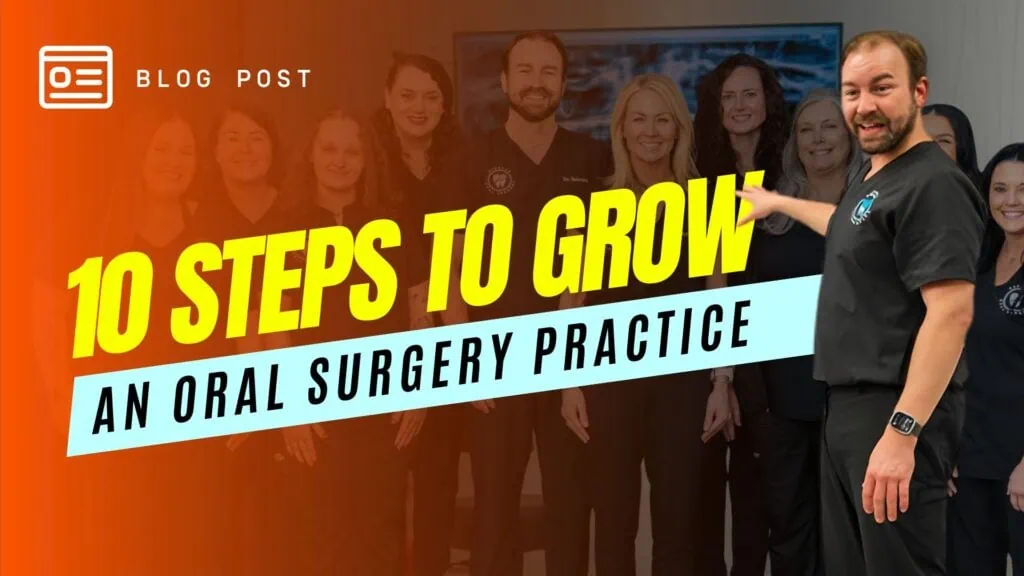
Growing an oral and maxillofacial surgery practice has never been about doing “more marketing.” It’s about building a repeatable patient-acquisition system that matches how oral surgery referrals actually happen — and how patients search, evaluate, and commit to care today.
In most markets, oral surgeons face pressure from three directions at once:
- General dentists and DSOs offering overlap procedures (implants, extractions).
- More aggressive local competitors investing in search, reviews, and referral pipelines.
- A modern patient journey that starts online, often in Google Maps or AI search, and ends with trust, clarity, and convenience.
The good news? Practices that fix the right levers see real jumps in case acceptance and volume. Below are 10 action steps we use to help oral surgery practices grow consistently — not just in traffic, but in booked consults, accepted treatment plans, and long-term referral dominance.
1. Define Your “Growth Procedures” and Build Around Them
Not every practice wants to grow the same way. Some want more:
- Dental implant cases
- Full-arch / All-on-X
- Wisdom teeth volume
- Pathology or trauma cases
- Orthognathic / airway / TMJ work
Growth gets faster when you choose a clinical focus and market it intentionally. Your messaging, visibility, and referral strategy should all amplify the same priority procedures.
Action step:
List your top 3 most profitable or preferred procedures. Then audit your website, Google profile, ads, and referral messaging to confirm they spotlight those procedures first.
2. Fix Your Google Business Profile to Win the Map Pack
If your practice isn’t in the top 3 Google Maps results, you’re invisible to high-intent patients. Most oral surgery searches are local, and the Map Pack often shows before traditional rankings.
Action step checklist:
- Primary category = Oral Surgeon (not “Dentist”)
- Add every core service as a listed service
- Upload real photos weekly (team, facility, tech, surgeon)
- Use Google Posts 1–2x/week
- Make sure your name, address, and phone number match everywhere online
Even small improvements here can increase calls and direction requests quickly.
3. Build a Review Engine (Not a “Review Ask”)
Reviews are modern word-of-mouth — and they influence both rankings and patient decisions. Oral surgery has a unique advantage: patients often feel intense relief and gratitude after treatment. The issue usually isn’t willingness — it’s lack of a system.
Action step:
Create a 2-part review process:
- Timing trigger: ask when the patient is most satisfied (post-op relief, follow-up success, implant finalization).
- Delivery trigger: send a text/email link immediately with simple instructions.
Bonus tip: encourage natural service language in reviews (e.g., “wisdom teeth,” “implants,” “jaw surgery”) without scripting them.
4. Upgrade and Protect Your Referral Pipeline
Oral surgery growth still lives and dies by referrals. But referrals don’t grow automatically. They grow when you create a reliable, low-friction experience for your referring offices.
Action step:
Build a “referral experience” around:
- Fast scheduling for referred patients
- Closed-loop communication back to the dentist
- Co-branded patient tools (post-op PDFs, implant guides)
- Quarterly referral scorecards (who’s growing vs. slipping)
Treat dentist relationships like a system you manage — not a hope you wait for.
5. Turn Your Website Into a Case-Acceptance Machine
A pretty site doesn’t grow a practice. A conversion-built site does.
Oral surgery patients are anxious, in pain, or facing a major decision. Your website must reduce uncertainty quickly.
Action step:
On every key service page, include:
- Clear “what this solves” framing
- Step-by-step procedure overview
- Surgeon credentials + hospital affiliations
- Real before/after or case examples (HIPAA-safe)
- Recovery expectations
- Financing/insurance clarity
- A bold call-to-action above the fold
Thin content doesn’t rank or convert. Clarity and depth win.
6. Create Content That Patients (and AI Search) Trust
Patients don’t just search “oral surgeon near me.” They search real questions:
- “Is wisdom teeth removal painful?”
- “How long does implant recovery take?”
- “Do I need a bone graft?”
Search engines and AI tools reward practices that answer these clearly and thoroughly.
Action step:
Build topic clusters around your growth procedures. Example for implants:
- Implant overview page (core)
- Bone grafting explainer
- Sinus lift explainer
- “Implants vs dentures” blog
- Cost + financing blog
- Post-op timeline/FAQ
This builds authority for rankings and patient confidence at the same time.
7. Add Video to Build Instant Trust
Oral surgery is high-trust care. Video builds trust faster than text.
Action step:
Start with 3 simple videos:
- Surgeon intro + philosophy (60–90 sec)
- Wisdom teeth reassurance (what to expect)
- Implant patient journey (procedure + success)
Publish on service pages, YouTube, and your Google profile. These improve conversion and visibility together.
8. Use Paid Ads to Fill Priority Gaps
SEO compounds, but it takes time. Smart paid ads fill the gaps you want now — especially for implants and wisdom teeth.
Action step:
Run ads for 1–2 priority services first, not everything. For each ad:
- Send traffic to a single-service landing page
- Include surgeon trust cues + reviews
- Keep contact options frictionless (call, form, chat)
- Track calls + booked consults, not clicks
Ads should accelerate growth, not create busywork.
9. Build a Follow-Up System That Saves Lost Cases
A lot of revenue is lost after the consult. Patients delay. They get busy. They scare themselves with the internet. Growth requires follow-up that’s consistent, calm, and helpful.
Action step:
Implement a 3-phase follow-up:
- 24-hour check-in after consult (text/email + next steps)
- 3–5 day education nudge (FAQ + reassurance)
- 2–3 week reactivation (offer to answer questions / schedule)
Even modest follow-up lifts case acceptance without increasing lead spend.
10. Track What Actually Drives Growth (Not Vanity Metrics)
Most practices track traffic. Growth practices track patients and procedures.
Action step:
Create a simple monthly dashboard:
- New patients by source (referral vs organic vs ads)
- Consults booked
- Consults completed
- Case acceptance rate
- Procedures by category (implants, wisdom teeth, etc.)
- Top referrers trending up/down
- Google profile calls + direction requests
- Review count and rating trends
Then make one improvement per month based on real numbers.
Putting It All Together: Growth Is a System
Most oral surgery practices don’t struggle because they’re missing everything. They struggle because they’re missing one or two core systems:
- A referral engine
- Local visibility
- Case acceptance
- Consistent follow-up
- Clear patient education
When these levers work together, growth becomes predictable — not seasonal or luck-based.
At HIP Creative, we help oral surgeons build this full loop: visibility → trust → consults → acceptance → referrals → repeatable momentum.
Next Steps (Start This Week)
If you want momentum fast, start here:
- Audit your Google profile category, photos, and services.
- Launch a review system with a consistent trigger.
- Pick one growth procedure and build a content cluster around it.
- Re-engage your top 20 referring offices with a clear support plan.
- Add follow-up automation to your consult process.
Do those five things well, and you’ll feel a measurable shift in case volume within the next quarter — without needing to “do everything.”